

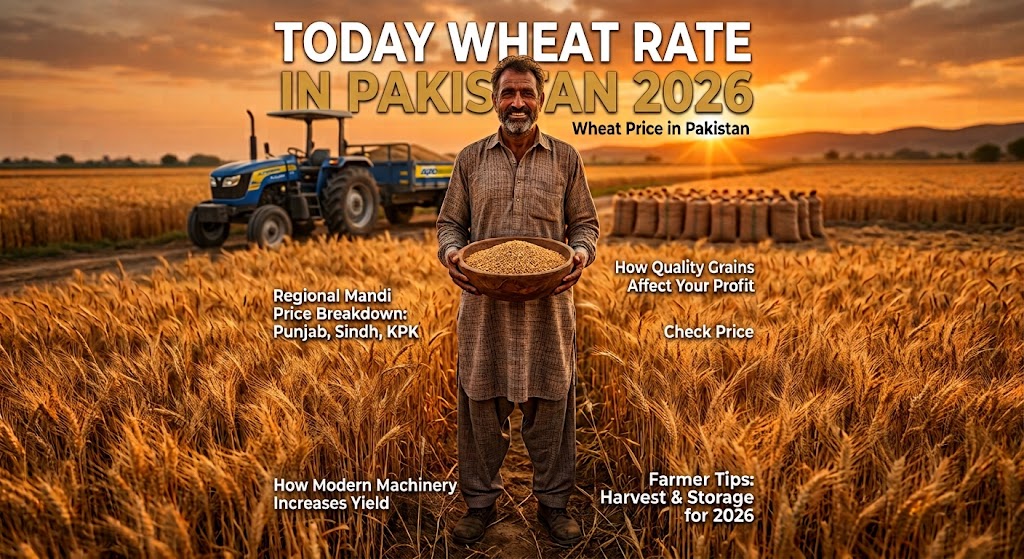
Today Wheat Rate in Pakistan 2026: Daily Mandi Prices & Market Trends
Managing agricultural produce requires keeping a close eye on crop prices. Whether you are a farmer planning your crop sales, a grain trader, or an agribusiness owner stocking up, knowing the today wheat rate in pakistan is essential for making smart financial choices.
Wheat (گندم) remains the backbone of Pakistan’s agricultural economy and food security. However, daily price fluctuations across local grain markets Today Wheat Rate in Pakistan (grain mandis) in Punjab, Sindh, Khyber Pakhtunkhwa, and Balochistan often create confusion. Factors such as government support pricing, regional supply chain costs, moisture content, and fuel rates directly influence local open market quotes.
In this guide, you will find updated market rates, province-wise breakdowns, major mandi comparisons, and actionable tips to help you get the best market value for your yield.
Quick Snapshot: Today Wheat Rate in Pakistan (Per Maund & Per Bag)
Wheat prices vary based on grain quality, cleanliness, moisture level, and geographic location. Dry, well-cleaned Grade-A wheat naturally commands a premium in open mandis.
-
Per 40 kg (1 Maund / من): PKR 3,600 – PKR 4,300
-
Per 100 kg (Jute / Poly Bag): PKR 9,000 – PKR 10,750
-
Per Metric Ton: PKR 90,000 – PKR 107,500
-
Government Minimum Support Price (MSP): PKR 3,900 – PKR 4,000 per 40 kg (Subject to official policy announcements)
Province-Wise Today Wheat Rate in Pakistan Breakdown
Prices differ significantly between surplus-producing agricultural hubs like Southern Punjab and consumption-heavy urban centers like Karachi and Peshawar due to freight costs and local demand dynamics.
| Province | Average Rate per 40 kg (PKR) | Average Rate per 100 kg (PKR) | Market Conditions |
| Punjab | PKR 3,600 – 3,950 | PKR 9,000 – 9,875 | High supply; steady trading in major mandis. |
| Sindh | PKR 3,750 – 4,100 | PKR 9,375 – 10,250 | Strong demand from flour mills in Sukkur and Karachi. |
| Khyber Pakhtunkhwa (KPK) | PKR 3,950 – 4,300 | PKR 9,875 – 10,750 | Higher rates due to inter-provincial transport margins. |
| Balochistan | PKR 4,000 – 4,350 | PKR 10,000 – 10,875 | Dependent on incoming grain arrivals from Sindh & Punjab. |
Major Grain Mandi Rates Across Pakistan
If you are taking your trolley to the local grain market or dealing directly with commission agents (Arhtis), use these major city benchmark Today Wheat Rate in Pakistan as a baseline:
-
Lahore Mandi: PKR 3,700 – 3,900 per 40 kg
-
Faisalabad Grain Market: PKR 3,650 – 3,850 per 40 kg
-
Multan / Khanewal Mandi: PKR 3,600 – 3,800 per 40 kg
-
Rahim Yar Khan: PKR 3,550 – 3,750 per 40 kg
-
Peshawar Grain Market: PKR 4,050 – 4,300 per 40 kg
-
Karachi Wholesale Market: PKR 3,900 – 4,200 per 40 kg
Note: Moisture content above 10-12% or high dust impurities will lead to deductions by buyers at the weighbridge.
Key Factors That Influence the gandam rate in pakistan today
Understanding why the wheat price in pakistan changes daily helps farmers and buyers time their trades effectively.
1. Government Procurement Targets & Support Price
When government agencies like PASSCO and provincial food departments actively procure grain at official support prices, open market rates remain stable. Reduced government buying shifts full volume onto private flour mills and traders, causing market volatility.
2. Moisture Level and Grain Quality
Freshly harvested wheat with high moisture levels decays faster during storage. Mandi buyers always offer higher rates for dry, clean, and uniform grains (Sāf Gandum).
3. Fuel & Transportation Costs
Diesel price revisions directly change freight charges per maund from agricultural centers like Bahawalpur or Sargodha to main urban consumption zones like Islamabad or Rawalpindi.
4. Farm Preparation & Maintenance Efficiency
For wheat growers, overall profitability isn’t just about selling prices—it also depends on keeping input costs low. Clearing crop stubble, maintaining field borders, and keeping irrigation channels clear without excessive labor overhead protects your profit margin. Utilizing efficient field machinery like the Honda UMK435 Brushcutter helps farmers clear thick weeds, crop stalks, and ditch banks quickly, cutting down manual labor costs before and after harvest.
How Wheat Rates Impact 20 kg Atta Bag Prices
The open market wheat rate directly dictates flour prices in retail shops. Processing, milling loss, packaging, and local transport add to the base grain cost:
-
Commercial Flour Mills Purchase Rate: Base grain rate + transport.
-
Chakki Atta (Whole Wheat Flour): Generally sells PKR 15–25 higher per kg than plain commercial flour due to traditional stone-milling retention of bran and germ.
-
20 kg Atta Bag Retail Average: Ranges between PKR 2,100 – 2,450 depending on the region and flour type (Fine, Super, or Whole Wheat Chakki).
Practical Tips for Farmers to Get the Best Wheat Price
To avoid selling at discount rates during peak arrival pressure, follow these field-tested practices:
-
Ensure Proper Sun-Drying: Never take wet or freshly cut damp wheat straight to the mandi. Dry your grain on clean tarpaulins until moisture drops below 10-11%.
-
Winnow and Clean Moisture/Dust: Use mechanical blowers or traditional winnowing to remove dust, chaff, and weed seeds. Clean grain routinely fetches PKR 100–150 more per maund.
-
Store in Moisture-Proof Bags: Use high-quality polypropylene or jute bags stacked on wooden pallets away from ground dampness.
-
Manage Field Water Efficiently: Preparing fields for the next crop cycle requires reliable farm equipment. Managing water supply and drainage effectively on your land using reliable machinery like the Honda WL30XH Waterpump ensures healthy field conditions for seasonal crop rotations.
-
Explore Diverse Agri Equipment: Investing in durable tools lowers long-term operational costs. Explore complete agricultural machinery and equipment solutions at Agromaster Pakistan to streamline your farming operations.
Frequently Asked Questions About gandam rate in pakistan today (FAQs)
What is today wheat rate in pakistan per 40 kg?
The current open-market wheat rate ranges between PKR 3,600 and PKR 4,300 per 40 kg (1 maund), depending on the city, moisture content, and overall grain quality.
What is the government support price for wheat in 2026?
The official minimum support price (MSP) set by government food departments generally benchmarks around PKR 3,900 – 4,000 per 40 kg, serving as a floor price for procurement.
Why are wheat rates higher in KPK and Karachi compared to Punjab?
Punjab is a surplus wheat producer, whereas KPK and Karachi rely on inter-provincial grain transport. Long-distance freight, loading/unloading fees, and local toll taxes increase retail rates in consuming regions.
How does moisture affect wheat mandi prices?
Moisture levels above 12% make wheat susceptible to fungal growth and weevils during storage. Mandi traders apply price deductions (often PKR 50–150 per maund) on damp grain to cover drying and storage risks.
What is the current price of a 20 kg flour (Atta) bag?
A standard 20 kg flour bag currently Today Wheat Rate in Pakistan costs between PKR 2,100 and PKR 2,450 in retail markets, depending on whether it is commercial fine flour or stone-ground whole wheat (Chakki Atta).
Conclusion
Keeping track of the Today Wheat Rate in Pakistan helps farmers, traders, and consumers make well-informed economic decisions. While market rates shift based on location, quality, and transportation costs, maintaining grain cleanliness and proper moisture levels ensures you receive the top rate in your local grain market. By combining smart storage, direct market monitoring, and efficient farm management, growers can maximize their returns every harvest season.
